AI-Powered AML & KYC Due-Diligence Platform for Compliance Teams
VaultIQ+ is the AI due-diligence platform we designed, built, and operate for InsightX. An analyst enters a person of interest; minutes later they have a structured risk report across eleven categories, with every claim linked to its source.
Overview
A complete due-diligence platform, not a chatbot
A compliance officer enters a person of interest. Minutes later, VaultIQ+ returns a structured risk report across eleven categories, from litigation history and sanctions exposure to adverse media and political connections.
Every summary links back to the original evidence, so an analyst can verify any claim before acting on it. The human stays in control of the decision; the AI does the heavy reading. And it is a complete SaaS product (identity, roles, billing, PDF export) built to the standard a regulated enterprise buyer expects.
Who it serves
- Compliance & AML teams
- KYC and due-diligence analysts
- Risk & onboarding functions
- Anyone vetting a person before they transact
What we owned, end to end
The Challenge
The bottleneck was never the information. It was reading it
A due-diligence specialist has to learn everything publicly knowable about a person, fast, and in a format another professional will trust. In practice that meant toggling between ten data sources, copy-pasting findings into a document, and hoping nothing slipped through.
Days per file
A single thorough background report could take a senior analyst one to several days of manual research.
Inconsistent quality
Depth and presentation varied by analyst and by how much time the deadline allowed.
The “did we miss something” risk
With evidence scattered across separate subscriptions, no one could be certain a material finding wasn’t overlooked.
Senior time on junior work
Expensive specialists spent their best hours assembling documents instead of making judgement calls.
Outcomes
What changed for InsightX
These are the platform’s design guarantees, not marketing estimates.
A report that took a senior analyst one to several days now arrives in minutes.
The same structured coverage across every subject, regardless of analyst or deadline.
Every AI summary links back to the primary evidence, defensible to a regulator.
Specialists stop assembling documents and start making judgement calls.
How It Works
Three coordinated layers, running in parallel
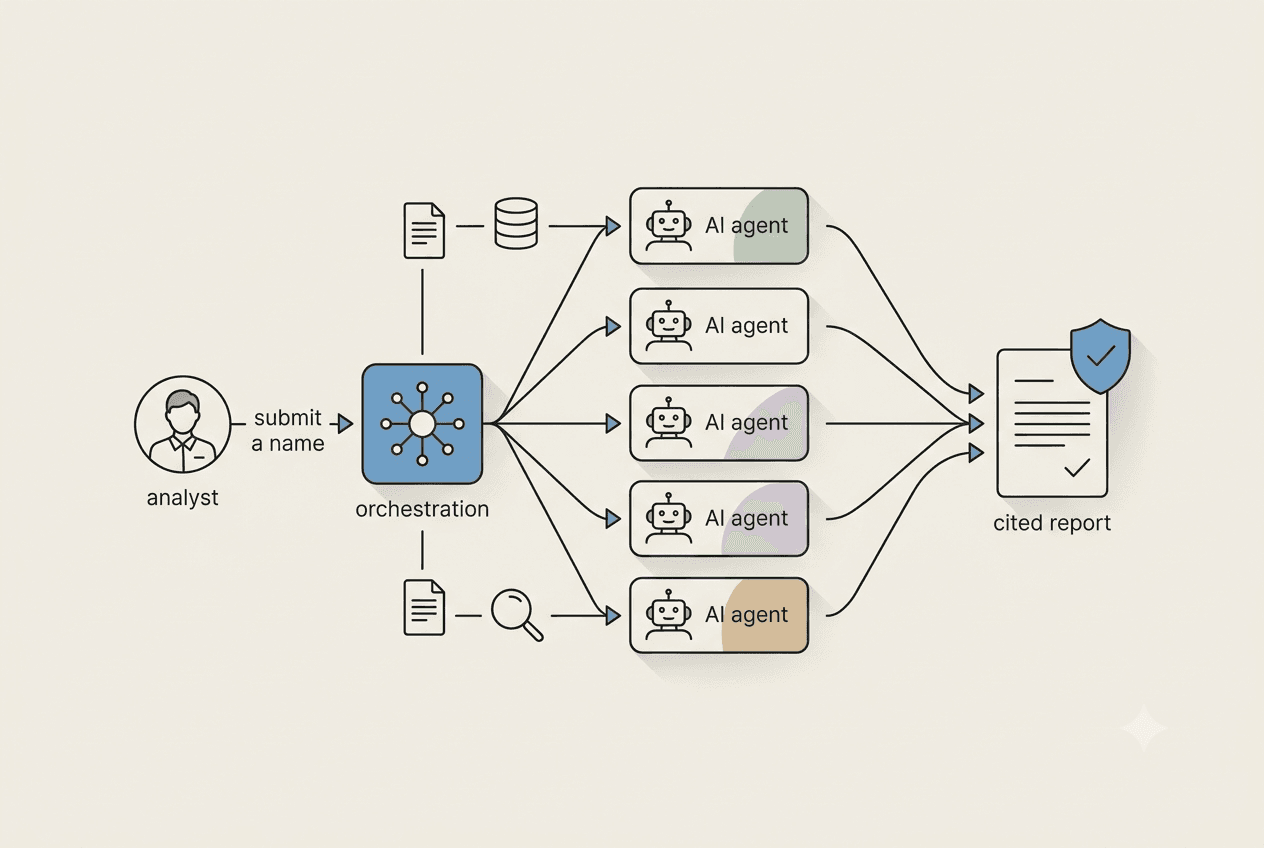
When a search is submitted, the work fans out across three layers in parallel: a deterministic retrieval layer, a retrieval-augmented generation (RAG) index, and a multi-agent reasoning fleet. A slow data source never holds up the rest of the report.
Deterministic data acquisition
Court records, sanctions and watchlists, news archives, government records, and KYC data are retrieved deterministically, each in its own pipeline. The evidence is real and traceable, never generated by the model.
Knowledge indexing (RAG)
Returned documents become a private, per-search retrieval-augmented generation (RAG) index, so each agent can pull exactly the evidence it needs.
Multi-agent reasoning & synthesis
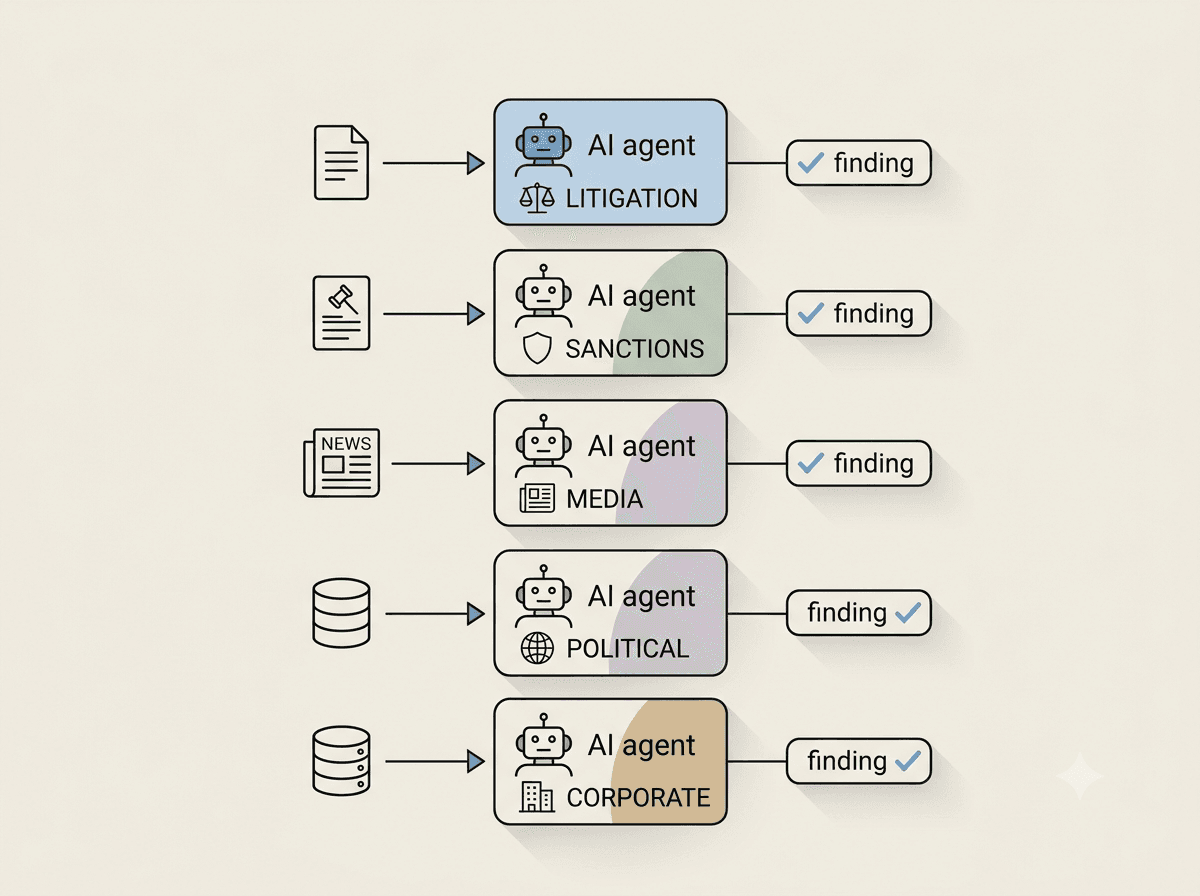
Eleven specialised AI agents (one per risk category), coordinated by a multi-agent orchestration layer, turn that evidence into findings: a summary, a risk signal, and citations back to the source.
System Architecture
Three coordinated layers, converging on one cited report
A single search fans out across three layers that run at the same time, so a slow data source never holds up the rest of the report. Each layer feeds the next, and every finding stays traceable to the evidence it came from.
Search submitted
An analyst enters a person of interest.
Deterministic acquisition
Court records, sanctions and watchlists, news archives, government and KYC data, each retrieved in its own pipeline. Evidence is real and traceable, never generated.
Knowledge index (RAG)
Returned documents become a private, per-search retrieval index, so every agent can pull exactly the evidence it needs.
Multi-agent reasoning
An orchestration layer coordinates the specialised agents, turning evidence into findings: a summary, a risk signal, and citations.
11 specialised agents
One per risk category, each with its own sources and quality checks.
Cited risk report
Eleven findings and an executive summary, assembled and delivered, with the right people notified.
Event-driven and orchestrated in the cloud: every step is independently observable, retryable, and runs in parallel.
Solution Planning
Agentic System Architecture
Before a line of code, we mapped the whole screening run as one flow. An orchestrator fans category tasks out to specialised agents that each retrieve their own context and reason over it, then a single assembler writes the cited report and returns status to the analyst.
A conceptual, technology-agnostic view of the pipeline. Node names are roles, not products.
The Agent Fleet
Eleven specialised agents, not one giant prompt
Each agent has one narrow job, its own sources, and its own quality checks, so any category can be improved without touching the others. Every finding ships with the evidence behind it.
A final step assembles the eleven findings and an executive summary into the report the analyst reads, then notifies the right people the moment it’s ready.
Under the Hood
Where the hard problems were
Building due diligence a regulator would accept meant solving for trust, not just speed. The five that mattered most:
The challenge
Stopping the model from inventing findings
How we solved it
The model is never the source of truth. A deterministic layer retrieves real evidence, RAG keeps generation grounded in it, and every claim cites its document. An uncited finding never ships.
The challenge
A single slow source holding up the whole report
How we solved it
Each data source runs in its own event-driven pipeline, in parallel. A slow or failing source degrades gracefully instead of blocking everything behind it.
The challenge
Keeping every client's data fully isolated
How we solved it
Separation is built into the data model, not bolted on. Every search, report, and notification belongs to one organisation, enforced by role and by organisation on every resource.
The challenge
Consistent depth across eleven categories
How we solved it
Instead of one giant prompt, eleven narrow agents each own a category with their own sources and checks, so any category can be improved and measured without touching the others.
The challenge
Improving quality without engineers in the loop
How we solved it
The client's experts capture a correction, propose a revision, and see it scored against a benchmark of verified reports before it activates, with one-click rollback. No deploy required.
End to End
From search to cited report, step by step
The same run, viewed as one pipeline. Each stage is independently observable and retryable.
Search submitted
A person of interest enters the queue.
Data acquisition
Deterministic pipelines pull evidence from licensed sources.
Knowledge index
Documents become a private, per-search retrieval index.
11 agents
Specialised agents reason over the evidence in parallel.
Report assembled
Findings and an executive summary compose into one report.
Delivered & notified
The report ships and the right people are alerted.
Continuous Improvement
The system gets sharper, under the client’s control
InsightX’s own experts steer report quality over time. No code, and no change reaches production unmeasured.
Experts correct the AI, not engineers
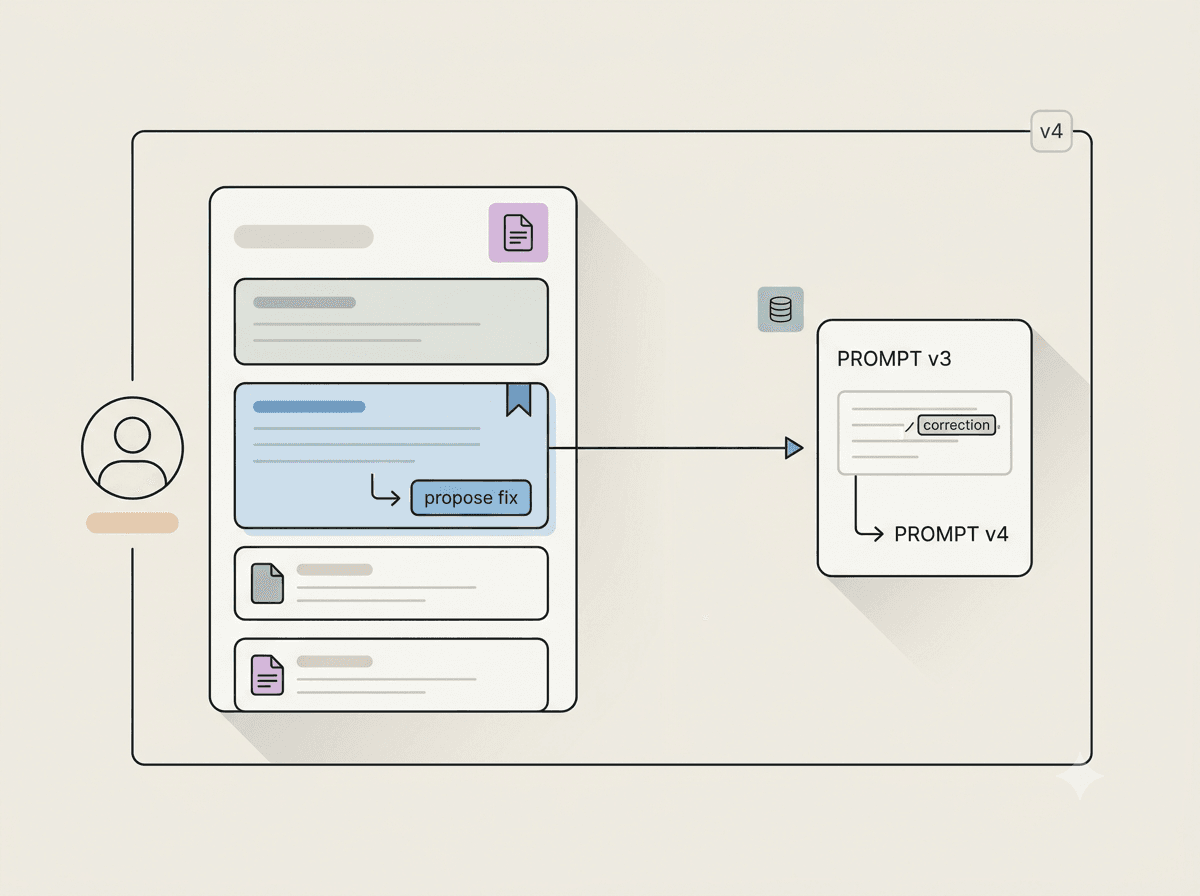
When a specialist spots a weak finding, they flag the exact report section, propose a fix, and roll it out, all in-app. The model is never edited by hand and no engineer sits in the loop, so the people who know the domain are the ones who improve it.
No change reaches production unmeasured
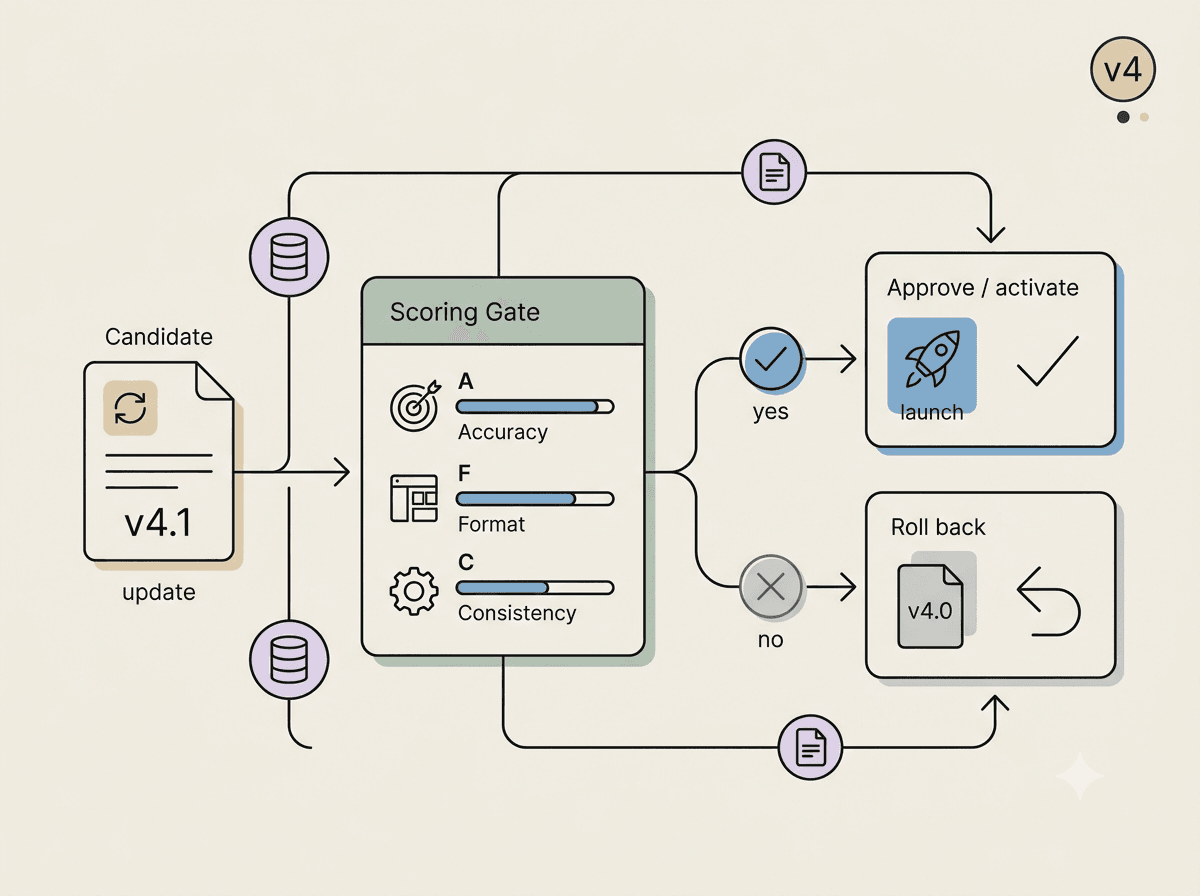
Every proposed revision is scored against a benchmark of verified reports before it can go live. If it does not beat the bar it does not ship, and any version rolls back in one click. Improvement is continuous, but never a gamble.
Experts correct the AI
Flag an issue on any report section, propose a fix, and roll it out, all in-app. No engineers needed.
Every change is scored
Each proposed change is scored against a benchmark of verified reports before it goes live, and any version can be rolled back.
In the client’s voice
InsightX’s own reports are built in as examples, so output matches their structure and tone from the first report.
Nothing is a black box
For any report, you can see exactly which evidence, instructions, and examples produced each finding.
Client Feedback
“At InsightX, we have been very fortunate to work with ObjectSingle and I cannot recommend them highly enough. They developed, from scratch, a secure platform with associated CMS for our reports and we are delighted with it. Always professional, responsive and friendly.”

Justin Williams
Co-CEO (Product), InsightX
“ObjectSingle has worked with us on the development of an editorial management platform and client interface. From initial brainstorming to the delivery of the final product, they worked as an integral part of our team. Always proactive, responsive, and available for support.”

Veronica Ferrari
Head of Insight, InsightX
Beyond VaultIQ+
The same architecture solves a whole class of problems
Wherever a knowledge worker is paid to read everything publicly knowable and produce a defensible recommendation, the VaultIQ+ pattern applies.
KYB & vendor onboarding
Multi-source data fusion and AI summarisation, applied to corporate entities instead of people.
M&A & investment research
An agent fleet over filings, news, patents, and ESG sources.
Insurance underwriting
Agents that read submissions, policy documents, and prior claims into a risk assessment the underwriter can act on.
Legal discovery & contract review
Section-level summaries with citation back to the exact clause.
Internal knowledge platforms
“Ask the AI, get cited evidence” over your own document repositories.
Common Questions
What buyers ask us about building AI like this
We never let the model be the source of truth. A deterministic retrieval layer pulls evidence from real data sources, then retrieval-augmented generation (RAG) keeps the AI grounded in that evidence: it only summarises and structures it, and every claim cites the document it came from. In a compliance setting, an uncited “finding” simply doesn’t ship.
Have a knowledge-worker bottleneck worth automating?
If your specialists spend their best hours reading documents instead of making decisions, the architecture behind VaultIQ+ likely applies. Let’s map it to your problem.